
If you own a pool in Florida, your deck takes more punishment than almost any other surface on your property. Between the relentless UV exposure — Florida consistently registers a UV index of 10 or higher from April through October — the daily cycle of afternoon thunderstorms, constant chlorine splashout, and the simple fact that everyone walks on it barefoot, a pool deck needs a coating system that's engineered specifically for these conditions. Standard interior epoxies, generic concrete sealers, and big-box paint products simply don't survive out here. They yellow, they peel, they get dangerously slippery when wet, and they burn bare feet on sunny afternoons.
This guide covers everything Florida homeowners need to know about pool deck coatings: which systems actually work in our climate, how non-slip technology keeps your family safe, what cool-touch surfaces are and why they matter, how to prepare your deck for coating, and what the installation timeline looks like from start to finish. Whether you're resurfacing a deteriorating deck or coating a brand-new pour, the goal is the same — a surface that looks great, stays cool, grips wet feet, and lasts for years without fading or peeling.
Why Florida Pool Decks Need Specialized Coatings
Florida's climate is uniquely destructive to concrete surfaces, and pool decks sit at the intersection of every environmental stressor the state has to offer. Understanding why standard coatings fail here is the first step toward choosing a system that won't.
UV Radiation and Solar Heat
Florida receives more annual UV radiation than almost any other state in the continental U.S. The UV index regularly exceeds 10 during summer months, which is classified as "very high" by the EPA. This level of ultraviolet exposure degrades most coating chemistries rapidly. Standard epoxy — which uses an aromatic isocyanate chemistry — will yellow, chalk, and become brittle within 6 to 12 months of direct sun exposure. The surface turns hazy, loses its color, and begins to flake. Beyond UV damage, bare concrete and dark-colored coatings absorb solar radiation and create surface temperatures that can exceed 150°F on summer afternoons. This is the "heat island effect" at work on your pool deck — and it makes barefoot use genuinely dangerous. Children, elderly family members, and pets are particularly vulnerable to thermal burns from overheated deck surfaces.
Afternoon Thunderstorms and Standing Water
From June through September, Florida averages afternoon thunderstorms nearly every day. These storms dump heavy rain in short bursts, flooding pool decks with standing water that takes time to drain — especially on flat or poorly graded concrete. A coating that isn't engineered for wet traction becomes a liability during and immediately after these storms. Moisture also penetrates improperly sealed concrete, causing hydrostatic pressure beneath the coating that leads to blistering and delamination. Any pool deck coating installed in Florida must be breathable enough to allow residual moisture vapor to escape while still providing a waterproof wearing surface.
Chlorine and Chemical Exposure
Pool water contains chlorine, bromine, muriatic acid, and other sanitizing chemicals that splash, drip, and puddle on the deck surface every single day. Over time, these chemicals attack coatings that lack proper chemical resistance. Acrylic sealers are particularly vulnerable — chlorine exposure causes them to whiten, soften, and peel within a year or two. Salt water pools present an additional challenge, as salt residue creates a corrosive film on the deck surface that accelerates coating breakdown. A professional-grade pool deck coating must resist continuous chemical exposure without softening, staining, or losing adhesion.
Florida pool decks sit at the intersection of every environmental stressor — extreme UV, daily thunderstorms, chlorine splashout, and barefoot traffic. Standard coatings simply don't survive.
Pool Deck Coating Types: A Side-by-Side Comparison
Not all pool deck coatings are created equal. The four most common systems used in Florida have dramatically different performance characteristics. This comparison table breaks down how each one handles the specific demands of outdoor pool environments:
| Property | Acrylic | Polyaspartic | Polyurea | Epoxy |
|---|---|---|---|---|
| Slip Resistance | Moderate | Excellent | Excellent | Moderate |
| UV Stability | Good | Excellent | Excellent | Poor |
| Heat Reflection | Moderate | Good | Good | Poor |
| Cost (per sq ft) | $3–$6 | $8–$15 | $10–$15 | $6–$10 |
| Lifespan (Florida) | 2–5 years | 8–15 years | 10–15 years | 3–7 years |
| Chlorine Resistance | Poor | Excellent | Excellent | Good |
| Cure Time | 24–48 hrs | 4–6 hrs | 2–4 hrs | 48–72 hrs |
As the table makes clear, polyaspartic and polyurea coatings dominate in outdoor pool deck applications. Their aliphatic chemistry provides inherent UV stability — they won't yellow, chalk, or degrade under Florida's intense sun. They also resist chlorine, salt, and pool chemicals without softening or discoloring. Standard epoxy, while excellent for interior garage and warehouse floors, is a poor choice for outdoor pool decks because its aromatic chemistry breaks down rapidly under UV exposure.
Why Acrylic Falls Short
Acrylic deck coatings and resurfacers are the most common "budget" option for pool decks in Florida. They're inexpensive, widely available, and easy to apply. However, their performance in Florida's climate is consistently disappointing. Acrylic coatings form a thin film (typically 5–15 mils) that wears through quickly under foot traffic and pool furniture. They offer limited chemical resistance, and chlorine exposure causes whitening and peeling. Most acrylic pool deck coatings need to be reapplied every 2 to 3 years — which means the "low cost" advantage disappears quickly when you factor in repeated maintenance.
Why Polyaspartic and Polyurea Win
Polyaspartic and polyurea coatings are both members of the aliphatic polyurea family, which means they share the same core advantage: complete UV stability. They don't yellow, they don't chalk, and they don't lose gloss or color integrity under sustained sun exposure. Beyond UV performance, these systems offer exceptional chemical resistance, superior abrasion resistance, and the ability to accept anti-slip aggregates without compromising adhesion or appearance. Polyaspartic coatings are the more common choice for residential pool decks because they offer a slightly longer working time during application, which allows for better decorative effects and more even aggregate distribution.
Non-Slip Technology: How It Works
Slip resistance is the single most important performance characteristic for any pool deck coating. A beautiful, UV-stable, long-lasting coating is worthless if it sends someone to the hospital because they slipped walking from the pool to the patio door. Professional pool deck coatings achieve non-slip performance through anti-slip aggregates that are broadcast into the topcoat during application.
Types of Anti-Slip Aggregates
The two most common anti-slip aggregates used in pool deck coatings are aluminum oxide and silica (quartz sand). Each has distinct characteristics:
- Aluminum oxide — An extremely hard, angular aggregate that provides aggressive, long-lasting traction. Aluminum oxide particles maintain their sharp profile under foot traffic for years, which means the slip resistance doesn't degrade over time the way softer aggregates do. This is the preferred choice for pool decks with high traffic, steep slopes, or areas around diving boards and slides where slip risk is highest.
- Silica sand (quartz) — A more rounded aggregate that provides moderate slip resistance with a smoother barefoot feel. Silica is less aggressive than aluminum oxide, making it a good choice for residential pool decks where comfort underfoot is a priority and traffic levels are moderate. The tradeoff is that silica particles wear down faster than aluminum oxide and may need to be refreshed sooner.
- Polymer beads — Lightweight synthetic beads that provide subtle texture without the rough feel of mineral aggregates. Polymer beads are the softest option and are typically used in coatings where a smooth, almost velvety texture is desired. They offer less slip resistance than aluminum oxide or silica but are comfortable barefoot and aesthetically subtle.
Application Method
Anti-slip aggregate is broadcast (scattered) onto the wet topcoat immediately after it's applied. The installer spreads the aggregate evenly across the surface while the coating is still liquid, allowing the particles to partially sink into the resin. Once the topcoat cures, the aggregate is permanently locked in — the particles protrude slightly above the surface to create grip, but they're anchored firmly enough to resist being pulled out by foot traffic, pool furniture, or pressure washing. The density of the broadcast determines the level of texture: a light broadcast produces a subtle orange-peel feel, while a heavy broadcast creates a more aggressive, gritty surface.
Slip resistance is the single most important performance characteristic for any pool deck coating. Anti-slip aggregates are broadcast directly into the topcoat — permanently locked in, not painted on.
Cool-Touch Technology: Keeping Decks Barefoot-Safe
Surface temperature is a serious concern for Florida pool decks. Uncoated concrete or dark-colored surfaces can reach temperatures exceeding 150°F on a sunny afternoon — hot enough to cause first- and second-degree burns on bare feet. Cool-touch technology addresses this problem through a combination of infrared-reflective pigments and light color selection that reduce heat absorption and keep deck surfaces significantly cooler.
How Cool-Touch Pigments Work
Cool-touch or "heat-reflective" pigments are engineered to reflect near-infrared (NIR) radiation — the portion of the solar spectrum responsible for heating surfaces — while still absorbing visible light in the chosen color. This means a pool deck coated with cool-touch pigments in a medium tan color will appear the same shade as a standard tan coating, but its surface temperature can be 20°F to 40°F cooler in direct sun. The technology was originally developed for roofing membranes and military vehicle coatings, but it's become increasingly popular in pool deck applications where barefoot comfort and safety are paramount.
Color Selection Matters
Even without cool-touch pigments, color selection has a major impact on deck temperature. Lighter colors reflect more solar energy and stay cooler. The most popular cool-deck colors in the Tampa Bay area include:
- Desert Sand / Khaki — The most popular pool deck color in Florida. Neutral, clean, and stays noticeably cooler than medium or dark tones.
- Light Gray / Dove — Modern and sophisticated. Pairs well with contemporary home exteriors and hides dirt effectively.
- Sandstone / Warm Beige — A warm, natural tone that complements Florida's tropical landscaping and terra cotta roof tiles.
- Cool White — The coolest option available, but can create glare in direct sun. Best for covered or partially shaded deck areas.
At Proven Surfaces, we help homeowners select colors that balance aesthetics with thermal performance. A properly chosen cool-touch color can reduce surface temperature enough to make the difference between a usable deck and one that sits empty on summer afternoons.
Surface Preparation: The Foundation of Every Lasting Coating
No coating system — regardless of how advanced the chemistry — will perform if the concrete surface beneath it isn't properly prepared. Surface preparation is the single biggest factor in determining how long a pool deck coating lasts, and it's the step most commonly skipped or shortcut by inexperienced contractors.
Step 1: Pressure Washing and Decontamination
The entire deck surface is pressure washed at 3,000–3,500 PSI to remove dirt, algae, mold, sunscreen residue, and any previous sealer or coating that has failed. Florida pool decks are particularly prone to organic growth — algae, mildew, and mold thrive in the warm, humid environment around pools. These contaminants must be completely removed because they create a barrier between the concrete and the coating. Any residue left behind will cause adhesion failure.
Step 2: Crack and Spall Repair
Florida's expansive clay soils and seasonal moisture fluctuations cause concrete pool decks to crack, settle, and spall over time. Before coating, all cracks wider than a hairline are routed and filled with flexible polyurea joint filler that moves with the concrete rather than cracking again. Spalled areas (where the surface has chipped or flaked away) are patched with a polymer-modified cementitious overlay that bonds to the existing concrete and provides a smooth, uniform substrate for the coating.
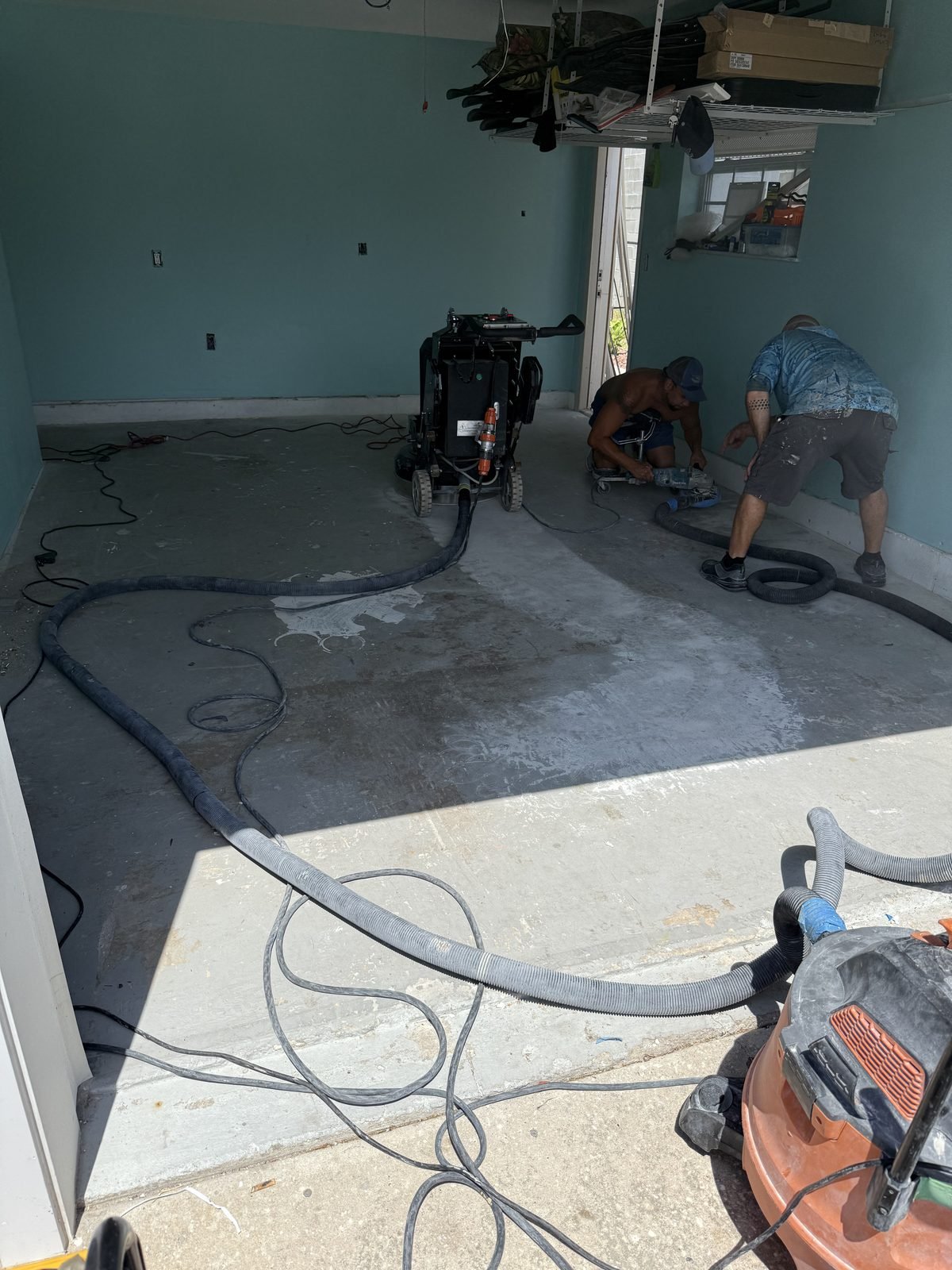
Step 3: Diamond Grinding or Shot Blasting
The concrete surface is mechanically profiled using diamond grinders or shot blasting equipment to achieve a CSP (Concrete Surface Profile) of 2 to 3. This process opens the pores of the concrete and creates the mechanical "tooth" that allows the coating to grip the surface permanently. Acid etching — which is still commonly used by budget contractors and DIYers — does not create a sufficient profile for high-performance coating systems and is never acceptable for pool deck applications where long-term adhesion is critical.
Step 4: Moisture Testing
Pool decks are constantly exposed to water from above (rain, splashout) and below (ground moisture wicking through the slab). Before any coating is applied, the concrete is tested for moisture vapor emission per ASTM F2170 standards using in-situ relative humidity probes. If moisture levels exceed the coating manufacturer's specifications, a moisture mitigation primer is applied to prevent hydrostatic pressure from pushing the coating off the slab. Skipping this step is the leading cause of pool deck coating failure in Florida.
Installation Timeline: What to Expect
One of the most common questions homeowners ask is how long the installation takes and when they can use their pool again. Here's a realistic timeline for a typical residential pool deck coating project in the Tampa Bay area:
Day 1: Preparation
The crew arrives early to pressure wash the entire deck, perform crack and spall repairs, and begin diamond grinding. All pool furniture, planters, and accessories are moved off the deck. The pool itself remains filled and operational — the coating is applied to the deck surface only, not the pool shell. Preparation typically takes a full day for an average-sized residential pool deck (400–800 sq ft).
Day 2: Primer and Base Coat
Once the surface is clean, dry, and profiled, a penetrating epoxy or polyaspartic primer is applied to seal the concrete and create a bonding bridge. After the primer tacks, the base coat is applied — this is the layer that provides the color and the bulk of the system's thickness. For decorative systems, flake or quartz aggregate may be broadcast into the wet base coat at this stage.
Day 3: Topcoat and Anti-Slip Aggregate
The UV-stable polyaspartic or polyurea topcoat is applied over the cured base coat. Anti-slip aggregate is broadcast into the wet topcoat immediately after application. The topcoat locks the aggregate in place and provides the chemical resistance, UV protection, and gloss (or matte) finish that defines the final appearance. Polyaspartic topcoats cure rapidly — typically reaching foot traffic hardness within 4 to 6 hours.
Day 4: Final Cure and Return to Service
Light foot traffic is usually safe within 24 hours of the topcoat application. Pool furniture can be moved back within 48 hours. Full chemical resistance (chlorine, sunscreen, cleaning products) develops within 5 to 7 days. We recommend waiting at least 72 hours before allowing heavy furniture or wheeled items on the new surface.
For homeowners who need faster turnaround, polyurea systems can compress this timeline to 2 days thanks to their extremely rapid cure times. However, the preparation work — pressure washing, crack repair, grinding — cannot be shortcut regardless of the coating chemistry selected.
Maintenance: Keeping Your Pool Deck Looking New
One of the biggest advantages of a professionally applied pool deck coating is how easy it is to maintain compared to bare concrete, pavers, or acrylic resurfacing. The sealed, non-porous surface resists stains from sunscreen, food, drinks, and pool chemicals. Here's what ongoing maintenance looks like:
- Weekly — Rinse the deck with a garden hose to remove pollen, dirt, and pool chemical residue. This takes 5 minutes and prevents buildup that can dull the surface over time.
- Monthly — Mop with a pH-neutral cleaner and soft-bristle deck brush. Avoid ammonia-based or bleach-based cleaners, which can cloud the topcoat gloss. A mild dish soap solution works well for most routine cleaning.
- Annually — Inspect the deck for any wear patterns, especially in high-traffic areas around ladders, steps, and the main entry point from the house. Address any thin spots or scuffs with a localized topcoat touch-up before they develop into larger issues.
- Every 5–8 years — Consider a maintenance recoat. A light abrasion of the existing surface followed by a fresh topcoat application restores the original gloss, color, and slip resistance without the cost or disruption of a full system removal and reapplication.
A properly maintained pool deck coating needs only a light recoat every 5–8 years — not a full tear-out. That's the difference between a professional system and a budget sealer.
Common Mistakes to Avoid
Over the years, we've seen hundreds of pool deck coating failures across the Tampa Bay area. The same mistakes come up again and again:
- Using interior epoxy outdoors — Standard aromatic epoxy is not UV-stable. It will yellow, chalk, and degrade within months on an exposed pool deck. Always use aliphatic polyaspartic or polyurea for outdoor applications.
- Skipping moisture testing — Pool decks are constantly wet. Applying a coating over concrete with excessive moisture vapor will result in blistering and delamination, usually within the first rainy season.
- Acid etching instead of grinding — Acid etching does not create a sufficient surface profile for high-performance coatings. Diamond grinding or shot blasting is the only acceptable preparation method for polyaspartic and polyurea systems.
- Choosing dark colors — Dark colors absorb solar radiation and create dangerously hot surfaces. Even with cool-touch pigments, a dark charcoal or black deck will be significantly hotter than a light tan or gray. Always prioritize barefoot safety when selecting deck colors.
- Applying in high humidity — Florida's humidity regularly exceeds 80%. Coating application must be timed for low-humidity windows (typically early morning) to prevent moisture contamination, blushing, and adhesion failure. Professional crews monitor dew point and relative humidity throughout the installation process.
Cost Factors for Florida Pool Deck Coatings
Pool deck coating costs in the Tampa Bay area range from $6 to $15 per square foot depending on several key factors:
- Concrete condition — A deck with extensive cracking, spalling, or previous coating failure requires more preparation work, which adds to the total project cost. New concrete in good condition is the most economical to coat.
- Coating system — Basic acrylic resurfacing is the least expensive but also the least durable. Polyaspartic and polyurea systems cost more upfront but deliver 3 to 5 times the lifespan, making them more cost-effective over a 10-year horizon.
- Texture and aggregate — Heavy non-slip aggregate broadcast adds material and labor cost compared to a smooth or light-texture finish. Aluminum oxide aggregate costs more than silica sand.
- Deck size — Larger decks (800+ sq ft) typically have a lower per-square-foot cost because setup and preparation costs are spread across more area.
- Decorative effects — Custom color blends, multi-tone patterns, and decorative flake or quartz systems add to the total cost compared to a single solid color.
For a typical 500-square-foot residential pool deck in the Tampa Bay area, most homeowners invest between $4,000 and $7,500 for a complete polyaspartic system with non-slip aggregate and a UV-stable topcoat. This includes all preparation, crack repair, materials, labor, and a written warranty. Call Proven Surfaces at (727) 463-3174 for a free on-site assessment and detailed quote tailored to your specific deck.
Why Tampa Bay Homeowners Choose Proven Surfaces
At Proven Surfaces, every pool deck coating project follows the same professional process: diamond grinding to CSP 2-3, moisture testing per ASTM F2170, crack and spall repair, primer, base coat, and a UV-stable polyaspartic topcoat with anti-slip aggregate. We don't cut corners on preparation, we don't use interior-grade products outdoors, and we don't leave until the job meets our standards. Our crews have coated hundreds of pool decks across Tampa, St. Petersburg, Clearwater, and the surrounding Tampa Bay communities — and we stand behind every installation with a written warranty.
Whether your deck needs a fresh coating over new concrete or a full restoration of a failed surface, we'll assess the condition, recommend the right system, and deliver a result that lasts. No high-pressure sales, no bait-and-switch pricing — just honest recommendations backed by professional execution.
Frequently Asked Questions
The best pool deck coating for Florida is a polyaspartic or polyurea system with non-slip aggregate broadcast into the topcoat. These aliphatic coatings are UV-stable, meaning they won't yellow or chalk under Florida's extreme UV index. They also resist chlorine splashout, salt air, and standing water far better than standard epoxy or acrylic sealers. When combined with aluminum oxide or silica anti-slip aggregate, the system provides safe barefoot traction even when the deck is soaking wet.
Pool deck coating in the Tampa Bay area typically costs between $6 and $15 per square foot, depending on the condition of the existing concrete, the type of coating system selected, and the level of texture or decorative finish. Basic acrylic resurfacing falls on the lower end, while full polyaspartic or polyurea systems with non-slip aggregate and custom color blends are at the higher end. Factors like crack repair, leveling, and moisture mitigation can add to the total project cost.
Not when installed correctly. Professional pool deck coatings incorporate anti-slip aggregates — typically aluminum oxide or silica sand — that are broadcast directly into the topcoat during application. These aggregates create a textured, high-traction surface that remains slip-resistant even when wet. The level of texture can be adjusted from a light orange-peel feel to a more aggressive grit depending on the homeowner's preference and the deck's slope.
A properly installed pool deck coating with a UV-stable polyaspartic or polyurea topcoat will last 8 to 15 years in Florida's harsh climate. Longevity depends on the quality of surface preparation, the coating system used, and ongoing maintenance. After 8-15 years, most decks need only a recoat — light abrasion and a fresh topcoat — rather than full removal and replacement, which significantly reduces long-term cost.
Ready to get started?
Get your free on-site assessment and find out which pool deck coating is right for your Florida home.
Get Your Free Assessment →