
If you're a Tampa homeowner looking at your stained, pitted, or peeling garage floor and wondering what it would take to fix it for good, you're in the right place. Garage floor coatings have become one of the most popular home improvement projects in the Tampa Bay area — and for good reason. A professionally installed coating transforms an ugly concrete slab into a clean, durable, and visually impressive surface that handles everything Florida throws at it: humidity, heat, rain runoff, hot tires, and daily wear.
But Tampa isn't like other markets. The year-round humidity, intense UV exposure, and Florida's notoriously high water tables create conditions that destroy cheap coatings and expose sloppy prep work within months. This guide breaks down everything you need to know about garage floor coating in Tampa — from costs and coating types to the step-by-step process, timeline, and what separates a coating that lasts from one that fails.
Why Tampa Garages Need a Different Approach
Most garage floor coating failures in Tampa can be traced back to one of three problems: moisture, UV degradation, or inadequate surface preparation. Understanding why Tampa is different from northern or western markets is the first step toward making a smart investment.
Humidity and Moisture Vapor
Tampa's average relative humidity hovers between 73% and 90% year-round. That ambient moisture affects both the concrete slab and the coating process itself. Concrete is porous — it absorbs moisture from the ground below and the air above. In Tampa, where the water table can be just a few feet below the slab in neighborhoods like South Tampa, Seminole Heights, and along Bayshore Boulevard, moisture vapor transmission (MVT) is a constant issue. If a coating is applied over a slab with excessive moisture, it will delaminate — the coating literally lifts off the concrete because the moisture vapor has nowhere to go. This is why professional installers in Tampa always perform moisture testing (ASTM F2170) before applying any system, and why vapor mitigation primers are used far more frequently here than in drier states.
UV Exposure and Hot Tire Pickup
Tampa garages take more UV punishment than garages in most other cities. The garage door is open for hours — when you're working in the garage, loading the car, or simply because the door opener runs while you're home. That direct Florida sun hammers the floor coating, and standard epoxy will yellow and chalk within 12–18 months of UV exposure. Additionally, Tampa's heat means tire temperatures are significantly higher than in moderate climates. When you pull into your garage after driving on Tampa asphalt in July, your tires can exceed 160°F. Budget epoxy coatings cannot handle this — the hot tires soften the coating and literally peel the color off when you back out. This phenomenon is called "hot tire pickup," and it's one of the most common complaints from Tampa homeowners who went with a cheap coating.
The Florida Slab Problem
Florida concrete slabs are poured differently than slabs in other parts of the country. Many Tampa homes, particularly those in Westchase, New Tampa, Brandon, and the older neighborhoods of Palma Ceia and Hyde Park, sit on slabs that were finished with curing compounds or sealers during original construction. These surface treatments create a barrier that prevents coatings from bonding properly. They must be completely removed through diamond grinding before any coating system can be applied — acid etching alone will not cut through them.
Tampa's combination of year-round humidity, intense UV exposure, and high water tables creates conditions that destroy cheap coatings and expose sloppy prep work within months. The prep work is everything.
Garage Floor Coating Cost in Tampa
Let's talk numbers. The cost of a garage floor coating in Tampa depends on the system you choose, the condition of your existing concrete, and the size of your garage. Here's a realistic breakdown of what Tampa homeowners are paying in 2025:
| Coating System | Cost / Sq Ft | 2-Car Garage Total | Cure Time | Lifespan |
|---|---|---|---|---|
| Basic Solid Color Epoxy | $5 – $7 | $1,800 – $2,800 | 5 – 7 days | 5 – 10 years |
| Flake Epoxy | $6 – $9 | $2,400 – $3,600 | 3 – 5 days | 10 – 15 years |
| Metallic Epoxy | $8 – $12 | $3,200 – $4,500 | 3 – 5 days | 15 – 20 years |
| Polyaspartic System | $7 – $10 | $2,800 – $4,000 | 1 day | 15 – 20+ years |
These prices include professional diamond grinding, crack repair, moisture testing, and a multi-coat system with topcoat. Be cautious of quotes significantly below these ranges — they usually indicate water-based epoxy (which fails in Tampa's climate), acid-etch-only prep, or single-coat systems without UV-stable topcoats.
What Drives the Price Up?
Several factors can push your Tampa garage floor coating cost toward the higher end of the range:
- Moisture mitigation — If your slab fails moisture testing, a vapor mitigation primer adds $1.50–$3.00 per square foot to the project.
- Severe crack repair — Minor hairline cracks are included in standard prep, but structural cracks, heaving, or settling damage require routing, filling, and sometimes grinding to level, which adds to labor costs.
- Previous coating removal — If your garage floor already has a failed coating (common with DIY kits from big-box stores), that old material must be completely removed before the new system can be applied. This can add $1.00–$2.50 per square foot depending on how stubbornly the old coating adheres.
- Garage size — A standard 2-car garage in Tampa runs 400–500 square feet. Three-car garages, extended bays, and garages with workshops or storage areas run larger and cost proportionally more, though the per-square-foot rate typically drops as the area increases.
- Custom color and design — Custom flake blends, metallic color combinations, and logo or border work increase material and labor costs.
Coating Types Explained
Not all coatings perform equally in Tampa's environment. Here's what you need to know about each option:
Solid Color Epoxy
The most affordable option. A solid-color epoxy system applies a single pigmented epoxy coat over the prepared concrete, followed by a clear topcoat. It's clean, simple, and functional. In Tampa, solid-color epoxy works well when paired with a UV-stable polyaspartic or polyurethane topcoat — without that topcoat, the color will yellow within the first year from sun exposure through the garage door opening. Solid-color epoxy is popular with Tampa homeowners who want a clean, uniform look without decorative effects.
Flake Epoxy (Decorative Chip)
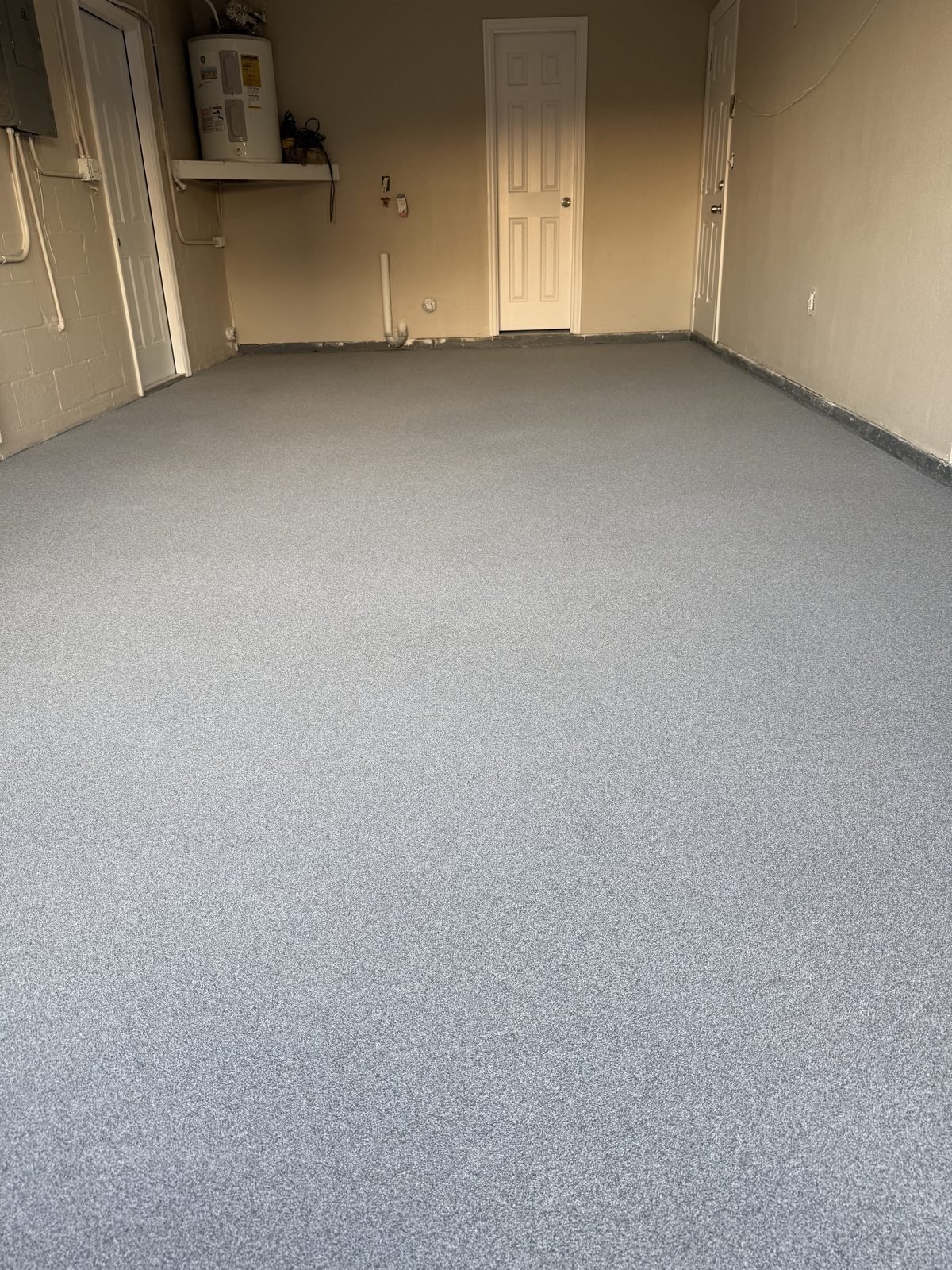
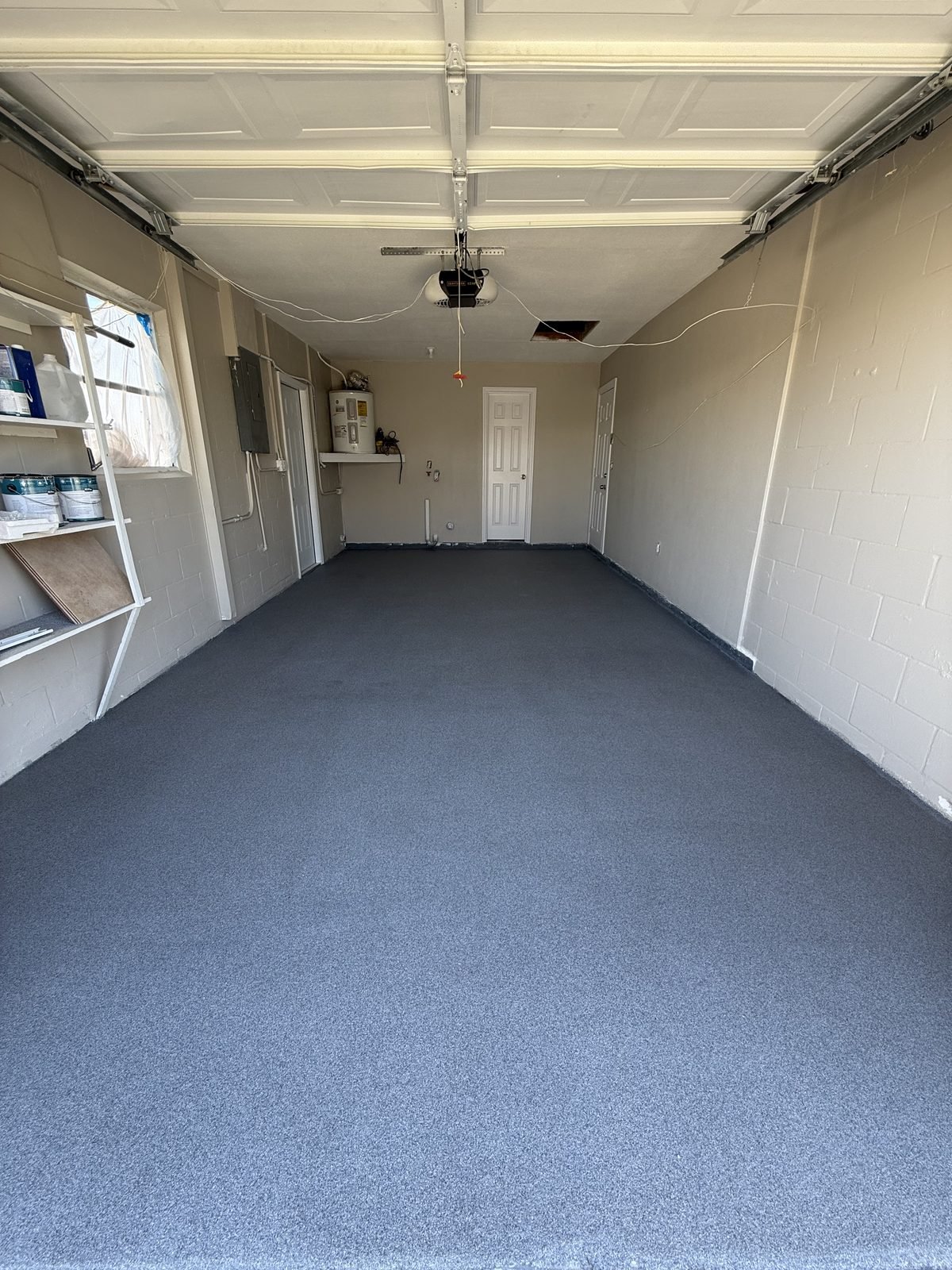
This is the most popular system for Tampa residential garages. A colored epoxy base coat is applied, then decorative vinyl flakes (also called chips) are broadcast into the wet epoxy to create a multi-toned, textured surface. The flakes add visual depth, hide minor imperfections, and provide a subtle anti-slip texture that's valuable when you're tracking in rain from Tampa's afternoon storms. The entire surface is then scraped, sanded smooth, and sealed with a clear polyaspartic or polyurethane topcoat. Popular flake color combinations for Tampa homes include saddle tan and cream (pairs well with stucco exteriors), cool grays and white (modern, clean look), and coastal blues with gray undertones.
Metallic Epoxy
The premium option. Metallic epoxy uses metallic pigment powders blended into clear epoxy resin to create flowing, three-dimensional patterns that look like liquid marble or molten metal. No two installations look the same. In Tampa, metallic epoxy is increasingly popular for homeowners in neighborhoods like Davis Islands, Harbour Island, Channelside, and South Tampa who view the garage as an extension of their living space — a showroom for their vehicles rather than just a parking spot. Silver, charcoal, and champagne metallic finishes are the most requested colors in the Tampa market. Metallic epoxy must always be topped with a UV-stable polyaspartic topcoat to prevent ambering from sun exposure.
Polyaspartic System
Polyaspartic coatings cure faster than any other system — a full installation can be completed and returned to foot traffic in a single day, with vehicle traffic in as little as 24 hours. This speed is a major advantage in Tampa, where afternoon thunderstorms and humidity can complicate multi-day projects. Polyaspartic systems are inherently UV-stable, so they won't yellow from garage door exposure. They also resist hot tire pickup far better than standalone epoxy systems. The trade-off is that polyaspartic is more expensive per square foot and requires highly experienced installers because the material's fast cure time leaves very little margin for error during application.
The Step-by-Step Process
Here's what to expect when Proven Surfaces — or any qualified professional — coats a Tampa garage floor from start to finish:
Step 1: On-Site Assessment
Before any work begins, a project manager visits your garage to evaluate the concrete condition, measure the space, identify existing coatings or sealers, and check for visible signs of moisture issues. At Proven Surfaces, owner John McGuire personally handles assessments across the Tampa Bay area because the evaluation stage is where most coating failures are prevented. If moisture is suspected, a calcium chloride test or ASTM F2170 in-situ probe test is scheduled. This assessment is free and takes about 30 minutes.
Step 2: Diamond Grinding (Day 1)
This is the most critical step. A planetary diamond grinder with industrial dust extraction is used to mechanically profile the concrete to a CSP (Concrete Surface Profile) of 2–3. Diamond grinding accomplishes several things simultaneously: it opens the pores of the concrete for maximum coating adhesion, it removes any curing compounds, sealers, or contaminants from the surface, and it creates a consistently flat surface by shaving down high spots. In Tampa, diamond grinding is non-negotiable. Acid etching — the prep method used by DIY kits and budget contractors — does not remove curing compounds and does not create a deep enough profile for 100% solids systems. Every coating failure we've seen in Tampa that was applied over acid-etched concrete has delaminated, usually within the first 6–12 months.
Step 3: Crack and Joint Repair (Day 1)
After grinding, all cracks, spalls, and control joints are addressed. Cracks are routed out with a diamond blade to create a clean channel, then filled with a flexible polyurea filler that bonds to both sides and remains flexible through Tampa's expansion and contraction cycles. Control joints (the lines cut into the slab during original construction) can be filled flush for a seamless look or left as-is based on homeowner preference. Divots and pitting from previous damage are filled and ground smooth.
Step 4: Moisture Testing (Day 1)
With the floor ground and repaired, moisture levels are tested per ASTM F2170 standards. In Tampa, we find that roughly 30% of residential garage slabs have moisture vapor transmission rates that exceed coating manufacturer specifications. When this happens, a vapor mitigation primer is applied before the coating system — this primer creates a barrier between the moisture in the slab and the coating above it, preventing delamination. Skipping this step is the single most common reason for garage floor coating failures in the Tampa Bay market.
Step 5: Base Coat Application (Day 2)
The base coat is mixed and applied to the prepared surface. For epoxy systems, this is a 100% solids epoxy rolled onto the floor at a controlled thickness using calibrated rollers. For flake systems, decorative chips are broadcast into the wet base coat by hand until full coverage is achieved — the technique matters here, as even chip distribution requires experience. For metallic systems, the metallic pigment is blended into clear epoxy and manipulated with rollers, squeegees, and denatured alcohol to create the flowing patterns. For polyaspartic base coats, the material is applied quickly and efficiently because the working time is significantly shorter than epoxy.
Step 6: Topcoat Application (Day 2–3)
After the base coat cures, the topcoat is applied. For flake systems, the floor is first scraped to knock down any protruding chips, then sanded smooth to create a uniform texture before the topcoat is rolled on. The topcoat is the shield — it provides UV stability, chemical resistance, abrasion resistance, and the final gloss level (high gloss, satin, or matte). In Tampa, we exclusively use polyaspartic topcoats for their superior UV stability and hot tire pickup resistance. Polyurethane topcoats are an acceptable alternative, but they take longer to cure and are slightly less resistant to hot tire marks in Florida's heat.
Step 7: Cure and Return to Service
After the final topcoat, the floor needs time to fully cure before use. Foot traffic is typically safe within 24 hours. Light items — storage shelves, tool boxes, bicycles — can be placed back on the floor after 48 hours. Vehicle traffic should wait a full 72 hours to allow the coating to reach full hardness. In Tampa's humid conditions, we always recommend erring on the longer side of cure times. Running a dehumidifier or fan in the closed garage during the cure period speeds the process and improves the final result.
Diamond grinding is non-negotiable. Every coating failure we've seen in Tampa that was applied over acid-etched concrete has delaminated within 6–12 months.
Popular Color Choices for Tampa Homes
Color selection is personal, but patterns emerge in the Tampa market. The most popular garage floor coating colors in the Tampa Bay area reflect the architectural styles and exterior palettes of Florida homes:
- Saddle Tan & Cream Flake — The most popular choice for Tampa homeowners with traditional stucco homes. Warm, neutral, and hides dirt and tire marks well.
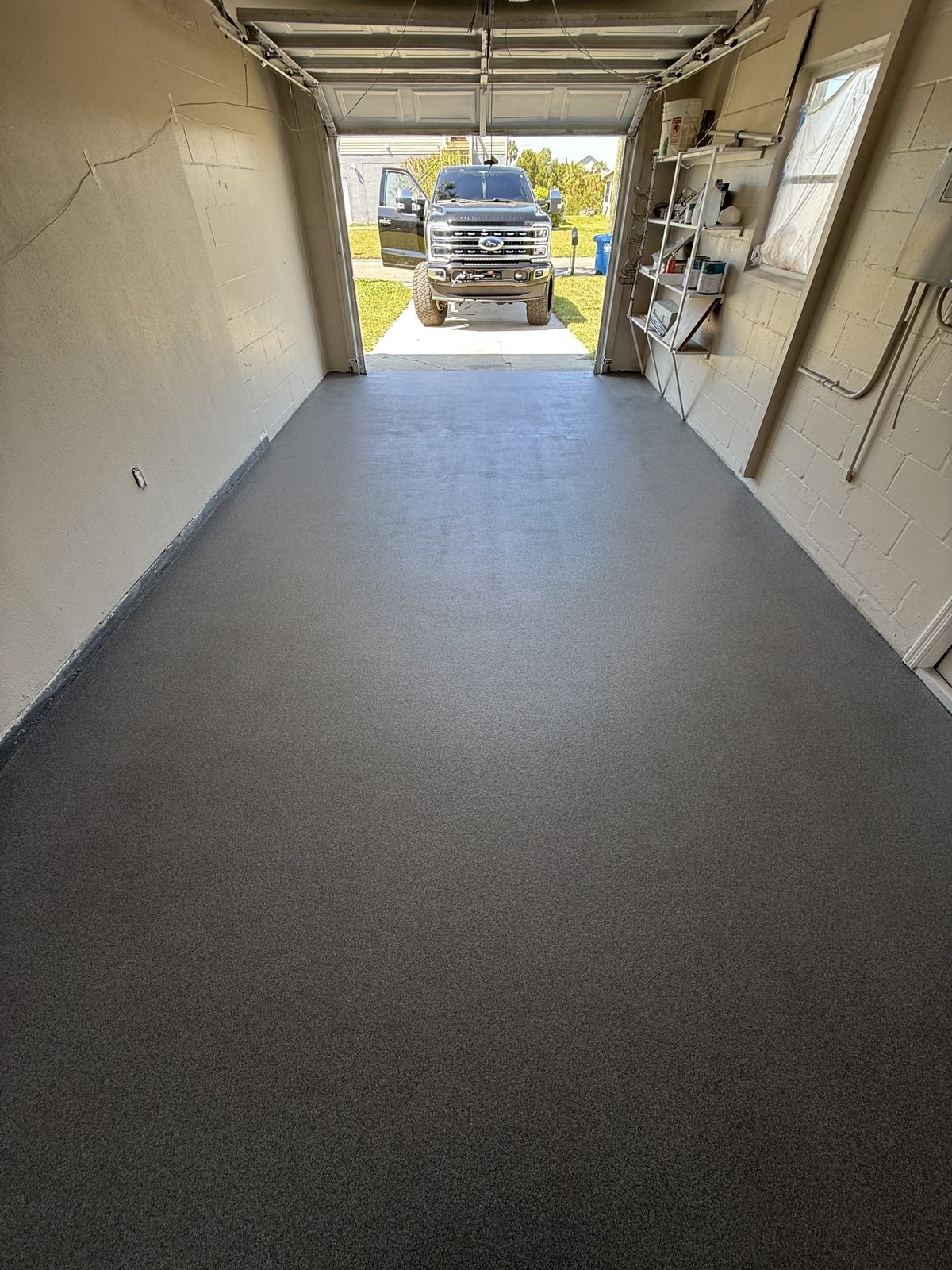
- Cool Gray & White Flake — Popular in newer construction in Wesley Chapel, Riverview, and New Tampa. Gives the garage a modern, clean-room look that pairs well with contemporary architecture.
- Mocha & Bronze Flake — A rich, warm option popular in Lutz, Land O' Lakes, and Westchase. Complements Mediterranean and Spanish-style homes.
- Silver Metallic — The go-to metallic color for Tampa luxury garages. Clean, modern, and reflects light to brighten the space.
- Charcoal Metallic — A dramatic, high-contrast option popular for car enthusiast garages in South Tampa and Davis Islands. Makes the vehicles pop against a dark, glossy floor.
- Solid Light Gray — Simple, affordable, and timeless. The most popular solid-color choice for homeowners who want a clean upgrade without decorative effects.
How Long Does a Garage Floor Coating Last in Tampa?
Longevity depends entirely on two factors: the quality of the system and the quality of the prep work. Here's what to realistically expect in Tampa's climate:
- DIY big-box store kits — 1–3 years before peeling, yellowing, and hot tire pickup. These water-based kits are not formulated for Florida's conditions.
- Basic solid-color epoxy (professional) — 5–10 years with a UV-stable topcoat. Without the topcoat, yellowing begins within 12–18 months.
- Flake epoxy with polyaspartic topcoat — 10–15 years with normal residential use. The combination of a 100% solids epoxy base and polyaspartic topcoat handles Tampa's heat and humidity without issue.
- Metallic epoxy with polyaspartic topcoat — 15–20 years. The thicker system and UV-stable topcoat provide the longest service life of any decorative option.
- Full polyaspartic system — 15–20+ years. The most durable system available. UV-stable throughout, fast cure, and inherently resistant to hot tire pickup.
At Proven Surfaces, John McGuire stands behind every installation with a written warranty that covers peeling, delamination, and hot tire pickup. Warranty terms vary by system — contact us at (727) 463-3174 for specific details on the system you're considering.
Maintenance: Keeping Your Tampa Garage Floor Looking New
One of the best things about a professionally coated garage floor is how little maintenance it requires. The sealed, non-porous surface resists stains, chemicals, and moisture — which is exactly what you need in a Tampa garage. Here's the simple maintenance routine we recommend:
- Weekly — Sweep or dust mop to remove sand, dirt, and debris. Tampa's sandy soil tracks in constantly, and sand is abrasive. Keeping it off the floor protects the topcoat's gloss.
- Monthly — Damp mop with warm water and a pH-neutral cleaner (like Simple Green diluted 10:1). No harsh chemicals, no ammonia, no abrasive scrub pads. The topcoat does the heavy lifting — all you're doing is removing surface grime.
- As needed — Wipe up oil, coolant, or chemical spills promptly. The polyaspartic topcoat resists chemical penetration, but prolonged exposure (24+ hours) can stain or soften the surface.
- Annually — Inspect the floor for any chips, scratches, or wear in high-traffic areas. Minor touch-ups are inexpensive and prevent larger issues down the road.
Avoid pressure washing the coated surface — it's unnecessary and can damage the topcoat over time. A standard garden hose rinse is sufficient for heavy cleaning. If your garage floods during Tampa's summer storms (it happens), squeegee the water out and allow the floor to air dry. The coating is waterproof — standing water won't damage it, but removing it promptly prevents mineral deposits.
Tampa Neighborhoods We Serve
Proven Surfaces installs garage floor coatings throughout the greater Tampa Bay area, including:
- South Tampa — Palma Ceia, Hyde Park, Beach Park, Bayshore Beautiful
- Central Tampa — Seminole Heights, Tampa Heights, Ybor City, Channelside
- North Tampa — New Tampa, Temple Terrace, USF area
- West Tampa — Westchase, Town 'n' Country, Carrollwood
- Brandon & Riverview — FishHawk Ranch, Valrico, Bloomingdale
- Lutz & Land O' Lakes — Suncoast area, Heritage Pines, Connerton
- Davis Islands & Harbour Island
- St. Petersburg & Clearwater — The full Tampa Bay metro
Frequently Asked Questions
A professional garage floor coating in Tampa typically costs between $1,800 and $4,500 for a standard 2-car garage (400–500 sq ft), which works out to roughly $5–$12 per square foot. The final price depends on the coating system you choose — solid-color epoxy is the most affordable at $5–$7 per square foot, while metallic epoxy is the most premium at $8–$12 per square foot. Factors that affect your total cost include the condition of your existing concrete, whether moisture mitigation is needed, previous coating removal, and custom color selections. Tampa's high humidity often requires additional prep steps that aren't necessary in drier climates, but these steps are essential for a coating that actually lasts.
Most professional garage floor coating projects in Tampa take 2–3 days from start to finish. Day 1 is dedicated entirely to surface preparation — diamond grinding the concrete to CSP 2–3, repairing cracks and joints, and performing moisture testing. Day 2 involves applying the base coat and, for flake systems, broadcasting the decorative chips. Day 3 is reserved for scraping, sanding (flake systems), and applying the UV-stable topcoat. After the final coat, you can walk on the floor in 24 hours, but vehicle traffic should wait a full 72 hours to allow the coating to reach full hardness. Tampa's humidity can extend cure times slightly, so we always build an extra half-day buffer into our project schedules.
The best garage floor coating for Tampa is a hybrid system: a 100% solids epoxy base coat paired with a polyaspartic topcoat. This combination gives you the best of both worlds. The epoxy base provides unmatched adhesion and chemical resistance, while the polyaspartic topcoat delivers UV stability (critical for garages with sun exposure through open doors), hot tire pickup resistance (essential in Florida's heat), and fast cure times even in high humidity. Standalone epoxy yellows in Tampa's sun. Standalone polyaspartic can be slippery when wet. The hybrid approach eliminates both weaknesses and delivers the longest service life — 15 to 20 years with normal use.
Yes — every crack must be addressed before coating. Cracks are routed out with a diamond blade to create a clean, uniform channel, then filled with a flexible polyurea or epoxy filler that bonds to both sides of the crack and remains flexible through temperature cycles. Just filling the crack isn't enough, though. You also need to identify why the crack formed. In Tampa, most garage floor cracks are caused by three things: settling (especially in new construction areas like Riverview and Wesley Chapel), thermal expansion and contraction from heat cycles, or moisture vapor pressure pushing up from the water table below the slab. If moisture is the underlying cause, a vapor mitigation primer must be installed across the entire slab before the coating system, or the coating will delaminate regardless of how well the cracks were repaired.
Ready to Upgrade Your Tampa Garage Floor?
Get a free on-site assessment from John McGuire and the Proven Surfaces team. We'll evaluate your concrete, test for moisture, and give you an honest quote — no pressure, no gimmicks.
Get Your Free Assessment →