
Every year, thousands of epoxy floor coatings fail prematurely — not because the product was defective, not because the installer was careless, but because of something invisible lurking beneath the surface. Moisture. It is the single most destructive force acting on concrete floor coatings, and it is the number-one reason epoxy systems delaminate, blister, and peel across residential, commercial, and industrial applications nationwide. The frustrating truth is that nearly every moisture-related failure is preventable with a single pre-installation step: proper concrete moisture testing.
At Proven Surfaces, we've seen the aftermath of skipped moisture tests on hundreds of jobsites. Coatings that looked flawless on day one are peeling in sheets three months later. The damage is expensive, disruptive, and entirely avoidable. This article explains exactly why moisture testing matters, how the industry-standard test works, what happens when contractors skip it, and what we do differently to protect every installation we deliver.
The Problem: Moisture Vapor Transmission
Concrete is not a solid, impervious material — it is porous. A standard 4-inch concrete slab contains millions of microscopic capillaries and pore structures that allow water vapor to migrate from the ground beneath the slab upward through the concrete and toward the surface. This process is called moisture vapor transmission (MVT), and it occurs continuously on every concrete slab that is in contact with soil, regardless of age.
When a concrete surface is left uncoated, this moisture simply evaporates into the air and causes no problems. But the moment you apply an epoxy coating — a dense, non-breathable membrane — you trap that moisture vapor between the slab and the coating. Hydrostatic pressure builds beneath the film. Within weeks or months, the coating begins to lose adhesion. Blisters form. Edges lift. In severe cases, entire sections of coating delaminate in sheets, exposing the bare concrete beneath.
Moisture is the single most destructive force acting on concrete floor coatings — and it is the #1 reason epoxy systems delaminate, blister, and peel nationwide.
The factors that increase moisture vapor transmission include slabs poured on grade without a vapor barrier, high water tables, poor site drainage, freshly poured concrete that hasn't fully cured, and slabs with inadequate or damaged polyethylene sheeting beneath them. Any of these conditions can push moisture levels past the point where standard epoxy systems can maintain adhesion — and without testing, there is no way to know until the coating has already failed.
ASTM F2170: The Industry Standard
The gold standard for concrete moisture testing is ASTM F2170 — the Standard Test Method for Determining Relative Humidity in Concrete Floor Slabs Using In Situ Probes. Unlike older surface-level tests, ASTM F2170 measures the relative humidity (RH) deep inside the slab itself, providing an accurate picture of the moisture conditions the coating will actually face once installed.
How the Test Works
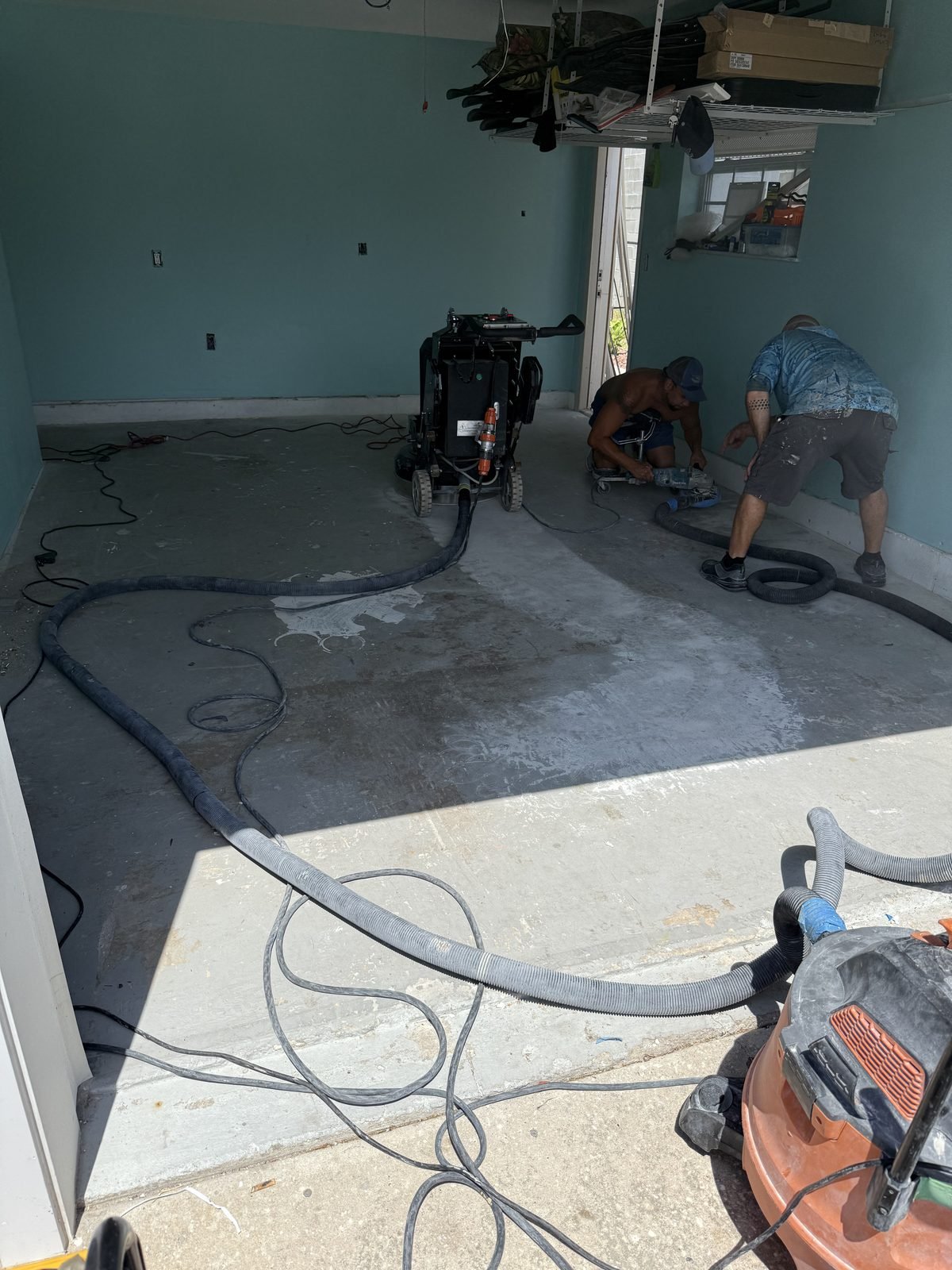
The testing procedure is straightforward but requires precision. Holes are drilled into the concrete slab to a depth of 40% of the slab thickness (for slabs drying from one side) or 20% (for slabs drying from both sides). Calibrated RH probes are inserted into the drilled holes, and the probes are allowed to equilibrate for a minimum of 72 hours. After equilibration, the probes are read to determine the internal relative humidity of the concrete at depth. A minimum of three test locations per the first 1,000 square feet is required, with one additional test for each additional 1,000 square feet.
What the Readings Mean
For most epoxy and polyaspartic coating systems, the critical threshold is 75% relative humidity. Readings at or below 75% RH indicate that the slab is dry enough to accept a standard coating system without risk of moisture-related failure. Readings between 75% and 85% RH enter a caution zone — some specialized coatings can tolerate these levels, but standard systems will fail. Readings above 85% RH indicate severe moisture conditions that require a dedicated moisture mitigation system before any coating can be applied.
| RH Reading | Status | Action Required |
|---|---|---|
| Below 75% | Acceptable | Standard coating systems can proceed |
| 75% – 85% | Elevated | Moisture-tolerant system or mitigation required |
| Above 85% | Critical | Full moisture mitigation system mandatory |
Why ASTM F2170 Is Superior to Calcium Chloride Testing
The older calcium chloride test (ASTM F1869) measures moisture vapor emission rate (MVER) at the slab surface. While it was the industry standard for decades, it has significant limitations. Surface moisture readings fluctuate with ambient temperature, humidity, and air movement — they measure what is happening at the surface at that moment, not what is happening inside the slab. ASTM F2170, by contrast, measures conditions at depth, where the coating bond line exists. It is more accurate, more repeatable, and more predictive of long-term coating performance. Every major coating manufacturer now specifies ASTM F2170 as the required pre-installation moisture test.
Case Studies: What Happens When You Skip Testing
Scenario 1: New Construction Warehouse
A 15,000-square-foot warehouse slab was poured and the general contractor scheduled epoxy coating installation just 28 days after the pour. The coating contractor applied a full-broadcast flake system without performing any moisture testing, assuming the slab was "dry enough." Within 90 days, sections of the coating began delaminating in large sheets — particularly in the center of the slab, where moisture levels were highest. The internal RH turned out to be 92%. New concrete typically requires 60 to 90 days per inch of thickness to dry to acceptable levels. The result: a complete tear-off and reinstallation at a cost exceeding $12,000, plus three weeks of downtime for the facility.
Scenario 2: Residential Garage — No Vapor Barrier
A homeowner invested $4,500 in a metallic epoxy system for their two-car garage. The slab was 30 years old, and the installer assumed age meant dryness. No moisture test was performed. What nobody checked was whether the original construction included a vapor barrier beneath the slab — it did not. Moisture migrated continuously through the porous concrete, and within 11 months, the metallic epoxy developed widespread blistering and edge lifting across the entire floor. The homeowner paid for a second complete installation, including a moisture mitigation primer — bringing their total investment to over $9,000 for what should have been a $5,000 job.
Scenario 3: Commercial Space — Passed Calcium Chloride, Failed ASTM F2170
A 6,000-square-foot retail buildout in a strip mall passed a calcium chloride test with a reading of 2.8 lbs/1,000 sq ft/24 hrs — well within the acceptable range. The contractor proceeded with a solid-color epoxy system. Within six months, isolated hot spots developed — bubbling and delamination in seemingly random patches across the floor. A follow-up ASTM F2170 test revealed RH readings of 82% to 88% at depth in those areas. The surface-level calcium chloride test had missed moisture migrating from a seasonal high water table that only elevated during wet months. The repair cost $8,200 and required partial moisture mitigation in the affected zones.
What We Do Differently
At Proven Surfaces, moisture testing is not optional — it is a mandatory step on every single project we take on, regardless of slab age, location, or the client's budget. We perform ASTM F2170 in-situ relative humidity testing on every slab before any coating work begins. Our process includes drilling test locations per ASTM specifications, inserting calibrated digital RH probes, allowing full 72-hour equilibration, and documenting every reading with photographic evidence and a written moisture report that becomes part of the project file.
We test slabs that are brand new. We test slabs that are 50 years old. We test slabs that "look perfectly dry." We test because we've seen too many coatings fail on slabs that looked fine to the naked eye but were transmitting destructive levels of moisture vapor from below. Our commitment to testing is why we stand behind our installations with confidence — and why our failure rate on moisture-related issues is effectively zero.
Professional ASTM F2170 moisture testing costs between $200 and $400. A moisture-related coating failure typically costs between $5,000 and $15,000. The math is simple.
Solutions for High-Moisture Slabs
A failed moisture test does not mean the project is dead — it means the slab needs additional preparation before coating. There are proven, engineered solutions for high-moisture conditions:
- Moisture Mitigation Epoxy Systems — Two-component epoxy systems specifically formulated to tolerate RH levels up to 99%. Products like Vapor-Tek 440 or Ardex MC Rapid create a permanent moisture barrier directly on the concrete surface, allowing standard topcoats to be applied over them.
- Cementitious Vapor Barriers — Portland cement-based overlays that chemically bond to the slab and block moisture transmission. These systems add 1/8" to 1/4" of thickness and can accept coatings within 24 hours of application.
- Specialized Primers — Moisture-tolerant epoxy primers designed for slabs with moderate elevation (75%–85% RH). These primers penetrate deeper into the concrete and maintain adhesion under higher moisture conditions than standard primers.
- Extended Dry Time — For new construction, sometimes the simplest solution is allowing additional cure time. Concrete slabs dry at approximately one month per inch of thickness under favorable conditions. Scheduling coating installation later in the construction timeline can eliminate the need for mitigation entirely.
The Bottom Line: Test Now or Pay Later
Professional ASTM F2170 moisture testing costs between $200 and $400 depending on slab size and the number of test locations required. A moisture-related coating failure — including tear-off, surface preparation, mitigation, and reinstallation — typically costs between $5,000 and $15,000, plus days or weeks of downtime. The math is simple. Testing is the single most cost-effective quality assurance step in any concrete coating project, and skipping it is a gamble with a predictable outcome.
If a contractor tells you moisture testing isn't necessary, find a different contractor. If they quote you a floor without mentioning moisture, ask why. And if the price seems too good to be true, it's almost certainly because critical steps like moisture testing have been removed from the scope to hit a lower number. The cheapest floor is never the one you pay for twice.
If a contractor tells you moisture testing isn't necessary, find a different contractor. The cheapest floor is never the one you pay for twice.
Ready to get started?
Get your free on-site assessment — including ASTM F2170 moisture testing on every project.
Get Your Free Assessment →